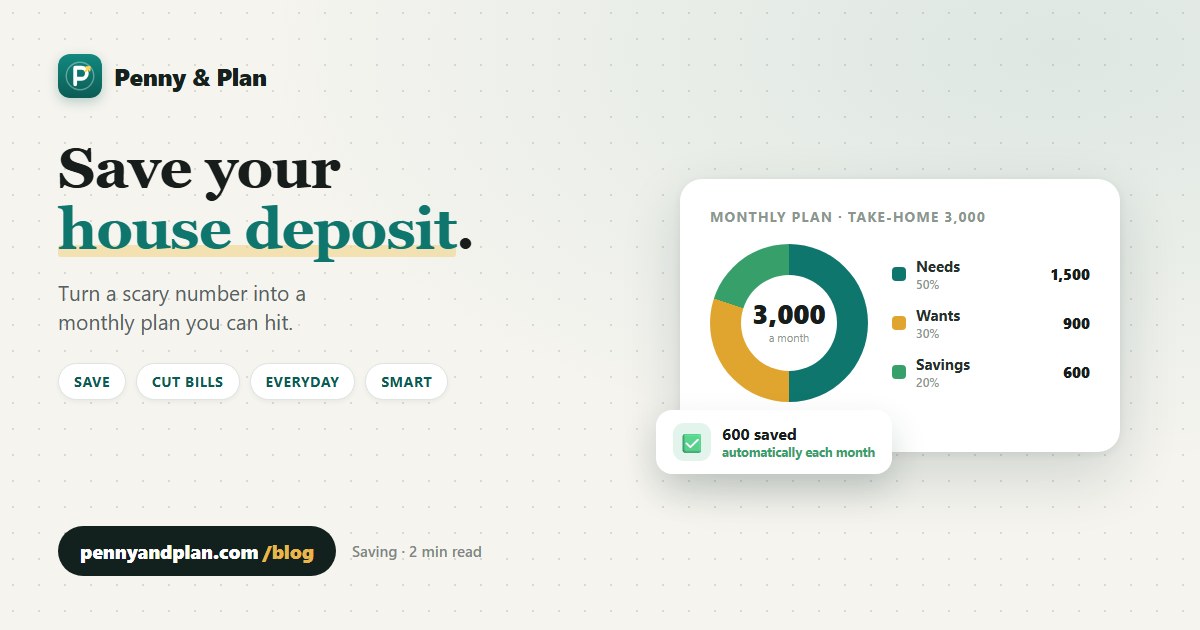
How to Save for a House Deposit (Even on a Normal Income)
Saving a house deposit can feel impossible, but it becomes far more manageable when you turn a scary lump sum into a clear monthly target and attack the biggest levers. The reason a deposit feels overwhelming is that the brain sees one enormous number with no obvious path to it. Break that number into a monthly amount, aim it at the right account, and protect it from your day-to-day spending, and the impossible becomes a schedule. Here is a realistic plan, with the reasoning behind each step and the country-specific help that can shave months or years off the journey.
Step 1: Work out your target
Start with a rough property price for the area and type of home you want. Then estimate the deposit percentage you are aiming for, often somewhere around 10 to 20% of the price, plus a buffer for buying costs like fees, legal work and moving.
Why the percentage matters so much comes down to how lenders price risk. A bigger deposit means you are borrowing a smaller share of the property's value, known as a lower loan-to-value ratio, and lenders reserve their best mortgage rates for lower-risk borrowers. That is why saving more up front is not just about the deposit itself, it can lower the interest you pay for years afterward.
That gives you a target number. It might look large, but the next step makes it concrete.
Step 2: Turn it into a monthly figure
Divide your target by the number of months until you want to buy. This is the move that converts dread into a plan.
- Target deposit of 24,000, aiming to buy in 4 years (48 months) = 500 a month.
- Same target in 3 years (36 months) = about 667 a month.
- Same target in 5 years (60 months) = 400 a month.
Now you have a real, trackable monthly goal instead of a vague dream. The table below shows how the three levers you control, the target size, the timeline and the monthly amount, trade off against each other.
| Target deposit | Timeline | Monthly saving needed |
|---|---|---|
| 20,000 | 3 years | about 556 |
| 20,000 | 5 years | about 333 |
| 30,000 | 4 years | 625 |
| 40,000 | 5 years | about 667 |
If the monthly figure is too high, you have three honest choices: extend the timeline, lower the target by looking at cheaper areas or a smaller first home, or raise your income. There is no fourth option that involves wishing, which is exactly why writing the numbers down helps.
Step 3: Pull the big levers
Small savings help, but the fastest progress comes from your biggest costs and your income. The maths is simple: shaving a few percent off a large recurring cost dwarfs cutting out small treats.
- Housing: if you can reduce rent, even temporarily, by sharing, moving somewhere cheaper, or staying with family, the savings are large and immediate because rent is usually the single biggest line in a budget.
- Transport: a cheaper car, or going car-light, frees serious money in many households once you count insurance, fuel and financing together.
- Income: extra hours, a side income, or a pay rise you save rather than spend can shorten your timeline dramatically, because every extra pound or dollar goes straight to the goal rather than being split with existing spending.
Trimming coffees is fine, but do not let it distract you from the levers that actually move the number. Saving 3 a day on coffee is real, yet it is a fraction of what moving to a flatshare or banking a raise can do.
Step 4: Automate and separate
Set up a standing transfer on payday into a separate account used only for the deposit. This works because of how spending psychology actually operates: money that never touches your current account is money you never feel you had, so you do not miss it. Keeping it separate stops it blending into everyday spending, and automating it means the saving happens before you can talk yourself out of it. Pay yourself first, then live on the rest.
Step 5: Keep it somewhere safe, and use the government help
Because you will need this money within a few years, it should not be exposed to big ups and downs. A stock market dip the month before you exchange contracts could wreck your plans, so a house deposit is one of the clearest cases for safety over growth.
- A high-yield savings account keeps the money safe, accessible and earning interest.
- If your country offers a dedicated first-home savings scheme with a bonus or tax advantage, use it, because that is often free money toward your goal.
- Avoid tying it up in investments that could drop in value right before you need it.
This is where the three countries diverge the most, and the differences are worth real money.
| Country | Key scheme to know | What it does |
|---|---|---|
| United States | Some states run first-time buyer savings or down-payment assistance programmes | Tax advantages or grants vary widely by state and lender |
| United Kingdom | Lifetime ISA | Government adds a 25% bonus on savings up to a yearly limit, for a first home under the price cap or for retirement |
| Canada | First Home Savings Account (FHSA) | Contributions are tax-deductible and qualifying withdrawals for a first home are tax-free |
United States. There is no single national first-home savings account, but the Consumer Financial Protection Bureau's "Owning a Home" resources are a solid starting point, and many states and cities run down-payment assistance or matched-savings programmes for eligible first-time buyers. It is worth checking what your state offers before defaulting to an ordinary savings account.
United Kingdom. The Lifetime ISA is the standout tool for many first-time buyers, adding a government bonus of 25% on what you save each year up to the annual limit, provided the home falls under the scheme's price cap and you follow the rules. Because ISA allowances are individual, a couple buying together can each hold one. Read the withdrawal conditions carefully, as taking money out for anything other than a first home or retirement can trigger a charge.
Canada. The First Home Savings Account combines the best of two worlds: contributions reduce your taxable income like an RRSP, and qualifying withdrawals for a first home come out tax-free like a TFSA. The long-running Home Buyers' Plan, which lets eligible buyers withdraw from an RRSP toward a first home, is another route. Both have their own limits and rules, so confirm current details before you rely on them.
The bottom line
Saving for a house deposit is really four moves: set a clear target, divide it into a monthly figure, attack your biggest expenses and income, and automate the saving into a separate high-yield account. Layer on the government-backed scheme your country offers, whether that is a Lifetime ISA in the UK, an FHSA in Canada, or state assistance in the US, because that is free help you would be leaving on the table. Do all of that consistently and a number that once felt impossible becomes a countdown you can actually watch shrink.
Frequently Asked Questions
How much deposit do I need to buy a house?
It varies by country and lender, but a common target is around 10 to 20% of the property price. A bigger deposit typically means a lower mortgage rate and smaller monthly payments, so saving more up front can save a lot over the life of the loan.
How can I save for a house deposit fast?
Set a clear target and deadline, automate a dedicated monthly transfer, cut your largest expenses like rent or a car where possible, and increase income with extra work. Big levers like housing and income move faster than trimming small everyday costs.
Where should I keep my house deposit savings?
For money you will need within a few years, keep it somewhere safe and accessible like a high-yield savings account or a dedicated first-home savings account if your country offers one with a bonus or tax benefit. Avoid risky investments that could fall right before you buy.
Sources
Primary sources used for this guide. Last checked August 10, 2026.
- Owning a HomeUS Consumer Financial Protection Bureau
- Lifetime ISAGOV.UK
- UK House Price Index reportsGOV.UK / HM Land Registry
Keep reading
 Saving
How to Save Money on Childcare Costs
The government schemes, tax breaks and care choices that cut childcare bills in the US, UK and Canada, and the order to claim them in so you never leave money on the table.
Saving
How to Save Money on Childcare Costs
The government schemes, tax breaks and care choices that cut childcare bills in the US, UK and Canada, and the order to claim them in so you never leave money on the table.
 Saving
How to Stop Wasting Food and Save Money
The average household throws away a large slice of the food it buys. Here is where that money actually goes and the short routine that stops it, without turning your kitchen into a spreadsheet.
Saving
How to Stop Wasting Food and Save Money
The average household throws away a large slice of the food it buys. Here is where that money actually goes and the short routine that stops it, without turning your kitchen into a spreadsheet.
 Saving
How to Save Money as a Student
Student saving starts with money you are entitled to and have not claimed: tax credits, council tax exemptions, hardship funds and bursaries, then the everyday costs.
Saving
How to Save Money as a Student
Student saving starts with money you are entitled to and have not claimed: tax credits, council tax exemptions, hardship funds and bursaries, then the everyday costs.